











WLTR turns raw instrument output into a verified, traceable, QA-approved calibration record. No retyping. No hidden math. No spreadsheet archaeology when an inspector asks for proof.
The same source data produces the same result, every time.
Every value links back to immutable raw instrument text.
Readiness, exclusions, criteria and QA approval stay with the record.
Each removes a specific point of failure between the instrument and the signed record.
Raw instrument text parsed, hashed and preserved — never retyped.
Raw instrument text is parsed, hashed and preserved — every number traces to its source.
Testing models and weighting schemes one at a time hides the best fit.
Every candidate model scored against 19 acceptance criteria, with the simplest passing model recommended.
Whole-group pass/fail triage — reviewers start at the exceptions, not page one.
Inspections surface decisions nobody documented at the time.
Frozen configs, owned exclusions, named QA approval — evidence stays with the record.
Analysts still export results, rebuild calculations in Excel, test weighting schemes by trial and error, hand-check acceptance criteria, and explain undocumented decisions months later. WLTR replaces that vulnerable middle layer.
The design is deliberately restrained: source integrity first, computation second, visibility third, approval last. Humans remain responsible for decisions. The system makes those decisions inspectable.
Ingest instrument output directly, parse it deterministically, and store the original text immutably with a SHA-256 hash so every downstream value traces to its source.
app.wltr.io / upload-run
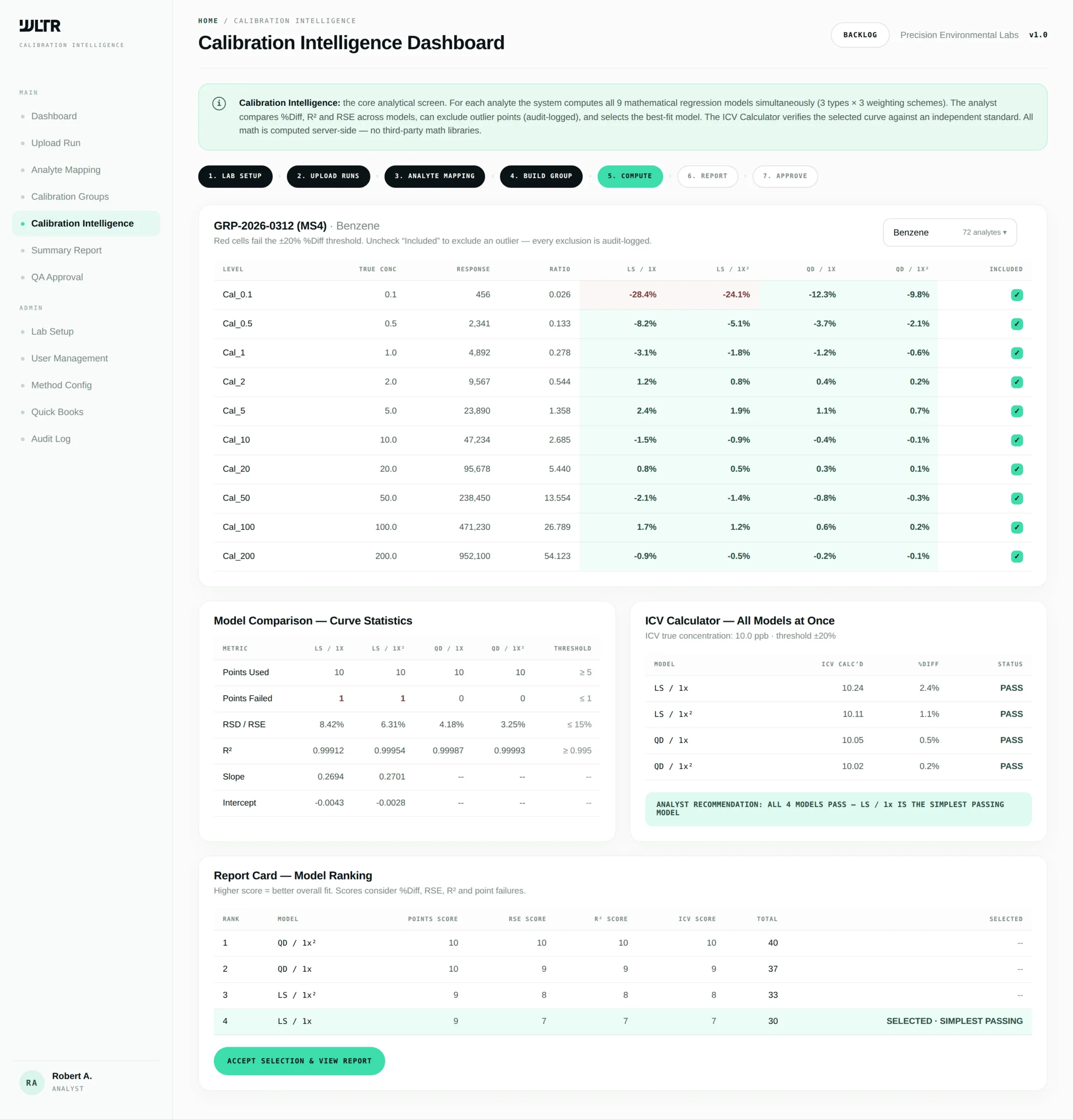
Evaluate every candidate model for every analyte against 19 acceptance criteria and display the calibration with simultaneous overlays — point-level %Diff, model fit and ICV recovery — without rebuilding the curve by hand.
app.wltr.io / calibration-intelligence
Aggregate calibration curves across every analyte and surface per-analyte pass/fail states, spotlighting trends and anomalies. Reviewers start with the exceptions instead of hunting for them.
app.wltr.io / analyte-mapping
Freeze the method configuration at compute time, log exclusions with user and reason, verify the ICV, and route the completed record through a named QA approval gate.
app.wltr.io / calibration-groups
Seven steps replace the fragmented spreadsheet stage without pretending laboratory judgment can be automated out of existence.
Define instruments, methods, acceptance criteria, users and QA roles.
Capture raw instrument text, metadata and source hashes before analysis begins.
Match raw compound names to canonical analytes and preserve aliases for future runs.
Generate the candidate models for each analyte and evaluate every level against the active criteria.
Package selected models, exclusions, ICV performance and method context into a consistent report.
Complete role-separated review with a named approver and permanent audit timeline.
Whole-group computation makes failed analytes visible immediately instead of burying them in repetitive manual review.
The active method configuration is snapshotted at compute time, so later changes do not rewrite historical results.
Removing a point becomes a recorded decision with who, when and why, not a disappearing spreadsheet row.