






One layer.
Every calibration defensible.
Deterministic clarity for calibration risk.
Every result your laboratory reports rests on a calibration someone approved. WLTR is the verification layer that proves each one — deterministically, traceably, before it can impact laboratory integrity.
Deterministic
The same source data produces the same result, every time.
Traceable
Every value links back to immutable raw instrument text.
Defensible
Readiness, exclusions, criteria and QA approval stay with the record.
Raw output becomes an auditable decision.

Designed around regulated laboratory reality
ICH M10
21 CFR Part 11
GLP
GMP
ALCOA+
ISO/IEC 17025
EPA SW-846
Manual oversight was never designed for this much data.
A bioanalytical lab builds a new calibration curve in every analytical run, and each one has to meet ICH M10’s back-calculated accuracy limits before a single study sample is reported. An environmental calibration group can span more than 100 analytes. Either way, the acceptance checks run into the thousands. Human review at that scale is not diligence. It is exposure.
Human oversight alone
- Error-prone and resource-intensive — failures surface late, or not at all.
- One analyte at a time — no context across the whole calibration group.
- Judgment calls live in spreadsheets and memory, not in the record.
- Inadequate audit trails turn routine inspections into findings.

deterministic oversight
- Every calibration verified by defined mathematics — the same way, every time.
- Whole-group visibility — reviewers start at the exceptions.
- Every decision, exclusion and approval attached to the record.
- Audit-defensible output ready the day the auditor arrives.
Four solutions. One verification layer.
Each removes a specific point of failure between the instrument and the signed record.
01
Data Integrity
Raw instrument text parsed, hashed and preserved — never retyped.
02
Calibration Intelligence
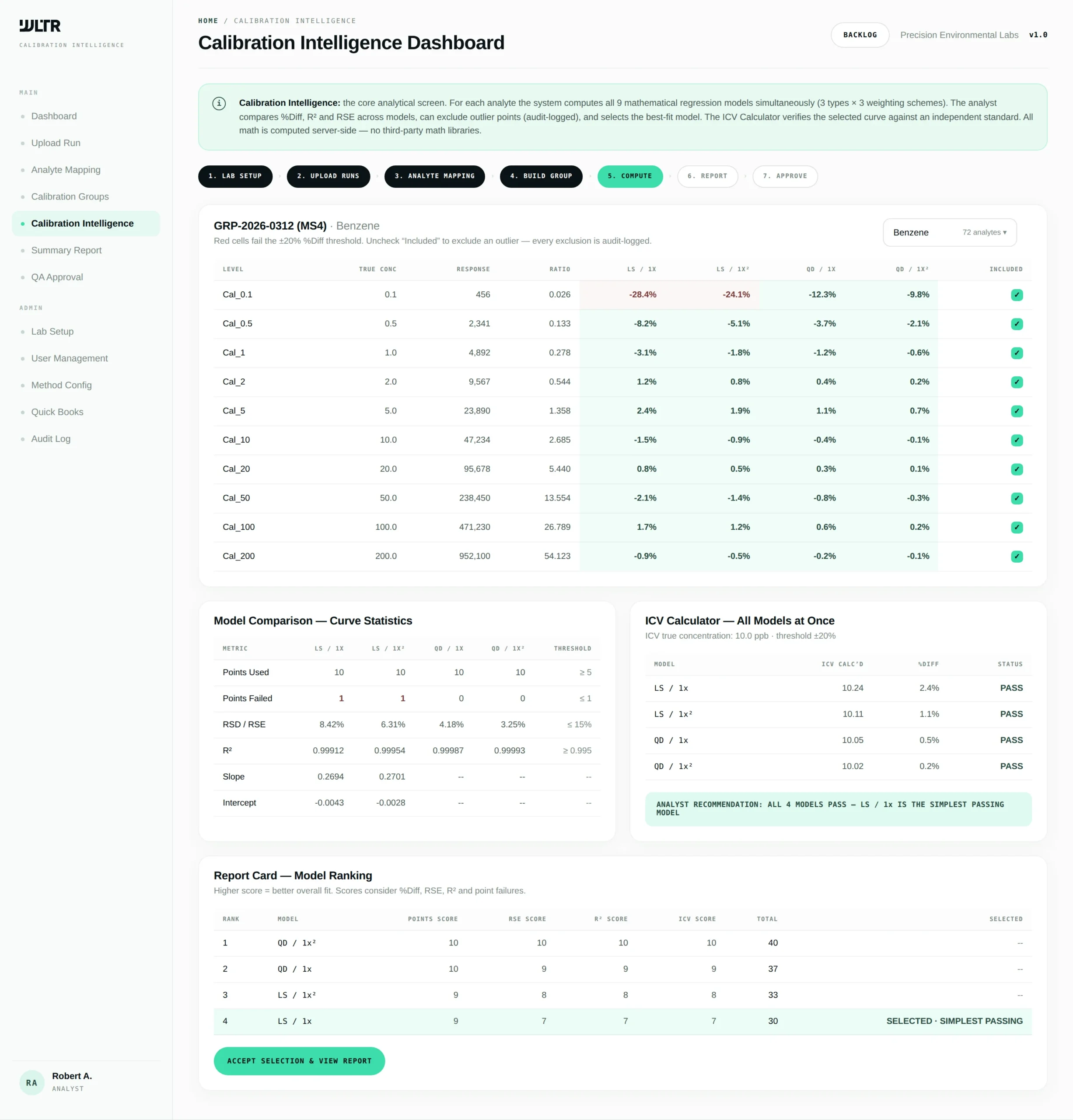
Every candidate model, every analyte, one field of view.
03
Multi-Analyte Visibility
Whole-group pass/fail triage — reviewers start at the exceptions.
04
Audit Defensibility
Frozen configs, owned exclusions, named QA approval.
The dashboard your QA team will live in.
app.wltr.io / calibration-intelligence
How much calibration risk are you carrying right now?
Calibration risk = probability of undetected deviation × regulatory impact. Count every calibration curve your team reviews: one per analytical run in bioanalysis, one per new ICAL in environmental work. The defaults are a starting point, so set them to your laboratory. The reduction levers are yours to set, not ours to claim.
Calibration Risk Inputs
Risk & Savings Results
An estimate from your inputs at 52 weeks a year. Not a quote.
Download Your Calibration Risk ReportEight regulated industries. One calibration problem.
We’re proving this in real laboratories — with five founding partners.
WLTR is new, and we would rather earn evidence than rent testimonials. Founding labs get white-glove onboarding, roadmap influence and founding pricing — and shape the proof everyone else will read.
See one calibration move from raw output to QA approval.
Bring a representative instrument export. WLTR will show the source record, candidate models, ICV verification, exceptions and approval trail in one controlled workflow.