







Pharma & Bioanalytical
Every calibration curve, verified before it reaches a study report.
Built for bioanalytical CROs and pharma QC laboratories. WLTR tests each curve against 19 acceptance criteria and gives your team documented evidence that the regression and weighting you report are the right fit for your data.

What WLTR adds to your data
Your CDS calculates a curve. WLTR shows whether it is the right one.
A passing r² does not prove a model is correct across a wide dynamic range. WLTR independently evaluates your calibration standards, ranks how well each established model describes the concentration response, and documents the result for every run and analyte.
Regression and weighting, justified with evidence
ICH M10 expects the regression model, weighting scheme, and transformation to be determined during validation and governed by written procedures. WLTR evaluates the candidate calibration models side by side against 19 acceptance criteria, so your choice is supported by data rather than habit.
See the bias a strong r² can hide
WLTR evaluates 19 acceptance criteria, including back-calculated accuracy at every level. Bias at the LLOQ and ULOQ surfaces before it reaches a concentration-time profile or a study report.
Consistency across runs, instruments, and analytes
Trend calibration performance across batches, instruments, and sites. Spot drift and recurring failures early, before they turn into rejected runs, reassays, or ISR investigations. Multi-analyte oversight
A record built for sponsors and inspectors
Every evaluation is documented and reproducible, giving QA, study directors, and sponsors a clear answer when they ask why a model and weighting were used. Audit defensibility
See it for yourself
Same eight standards. Three models. Three different answers.
Switch the regression model and watch what happens to back-calculated accuracy. The unweighted linear fit posts an r² above 0.998 and still fails at the low end. This is the gap WLTR is built to close.
How to read this: each dot is one calibration standard. The closer to the center line, the more accurately that standard is recovered. Pick a regression model:
Back-calculated accuracy by calibration level. Shaded band shows ICH M10 limits: ±15% of nominal, ±20% at the LLOQ. Illustrative data.
Inside WLTR
From raw export to a defensible record.
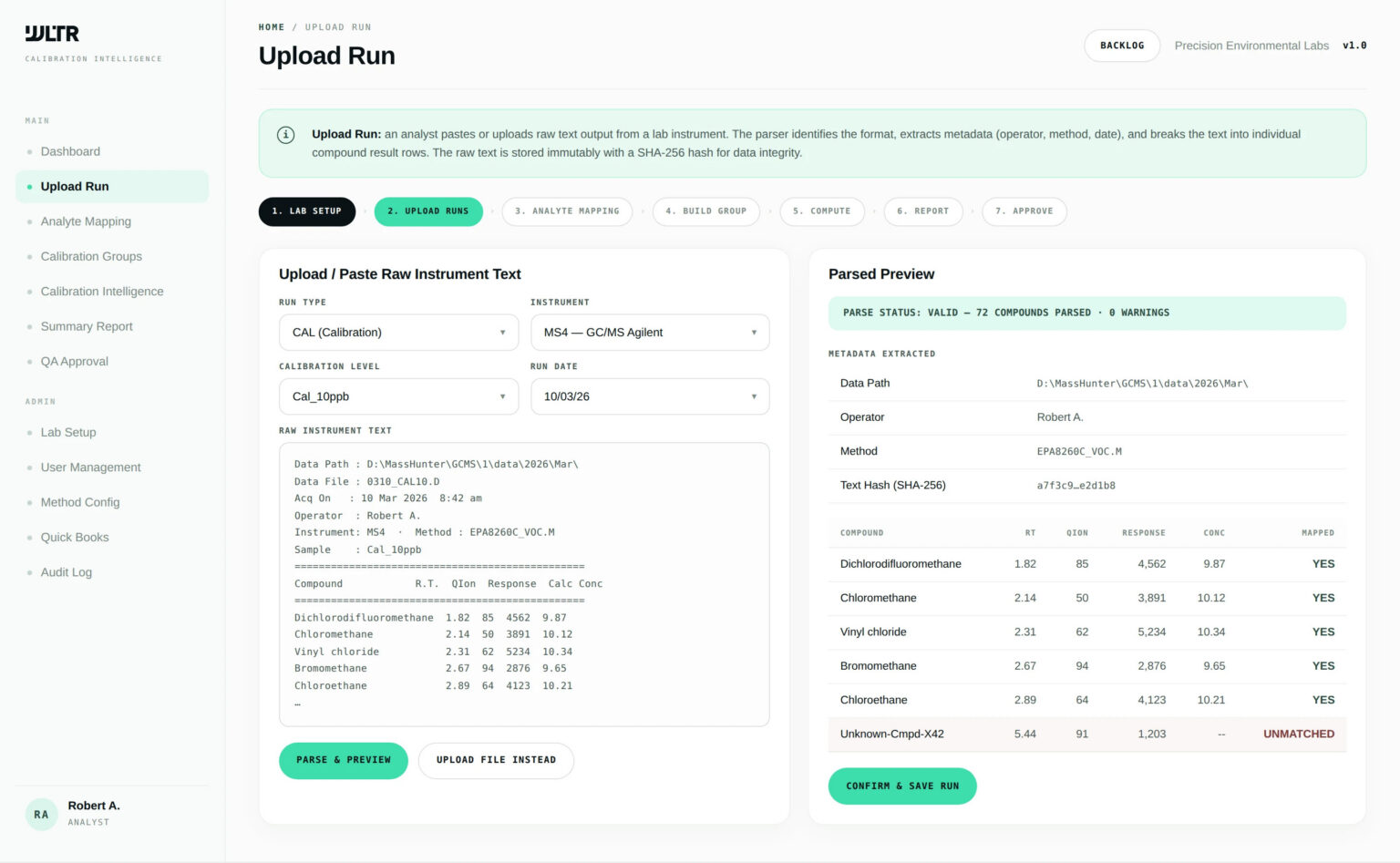
Step 01
Export from your CDS, upload the run.
Drop in the calibration export from your chromatography data system. WLTR parses the run, maps analytes, and confirms the instrument and method context. Nothing in your validated acquisition or processing changes.
Step 02
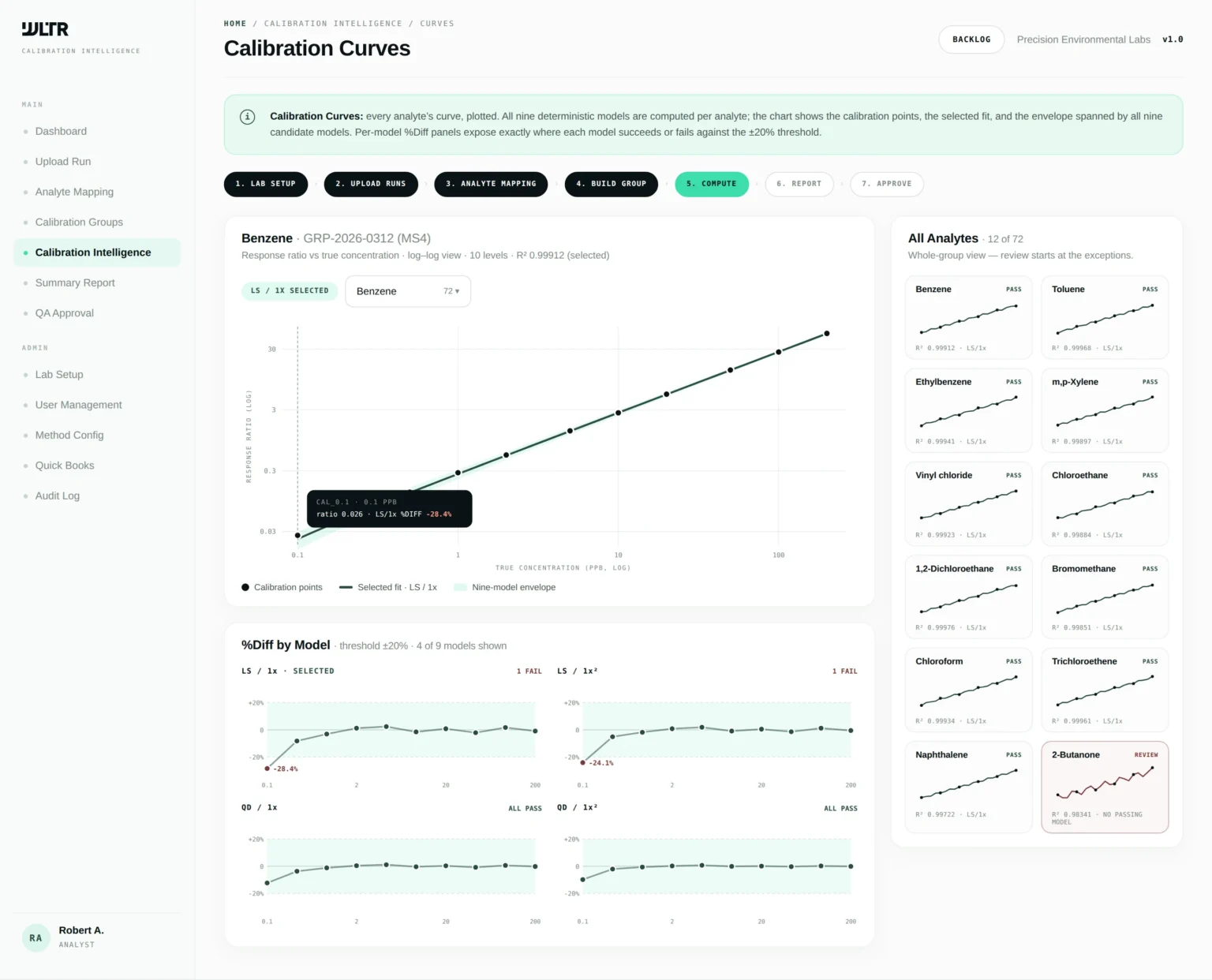
Every analyte, every model, side by side.
WLTR fits each analyte against the candidate calibration models and plots back-calculated accuracy by level, so curvature and low-end bias are visible at a glance.
Step 03
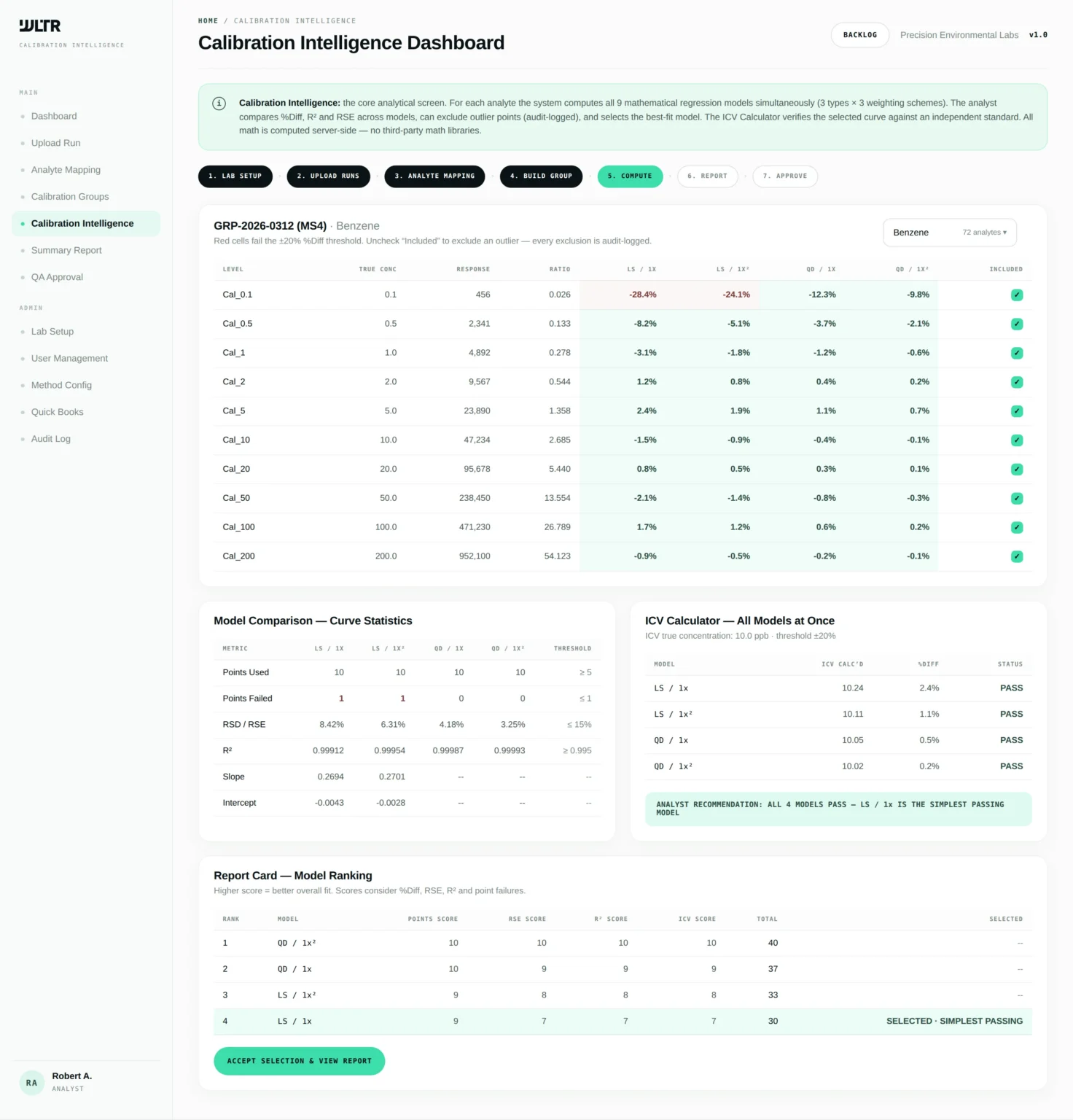
A ranked, documented recommendation.
All 19 acceptance criteria roll up into a ranked model comparison with a clear recommendation and the evidence behind it, ready for data review.
Step 04
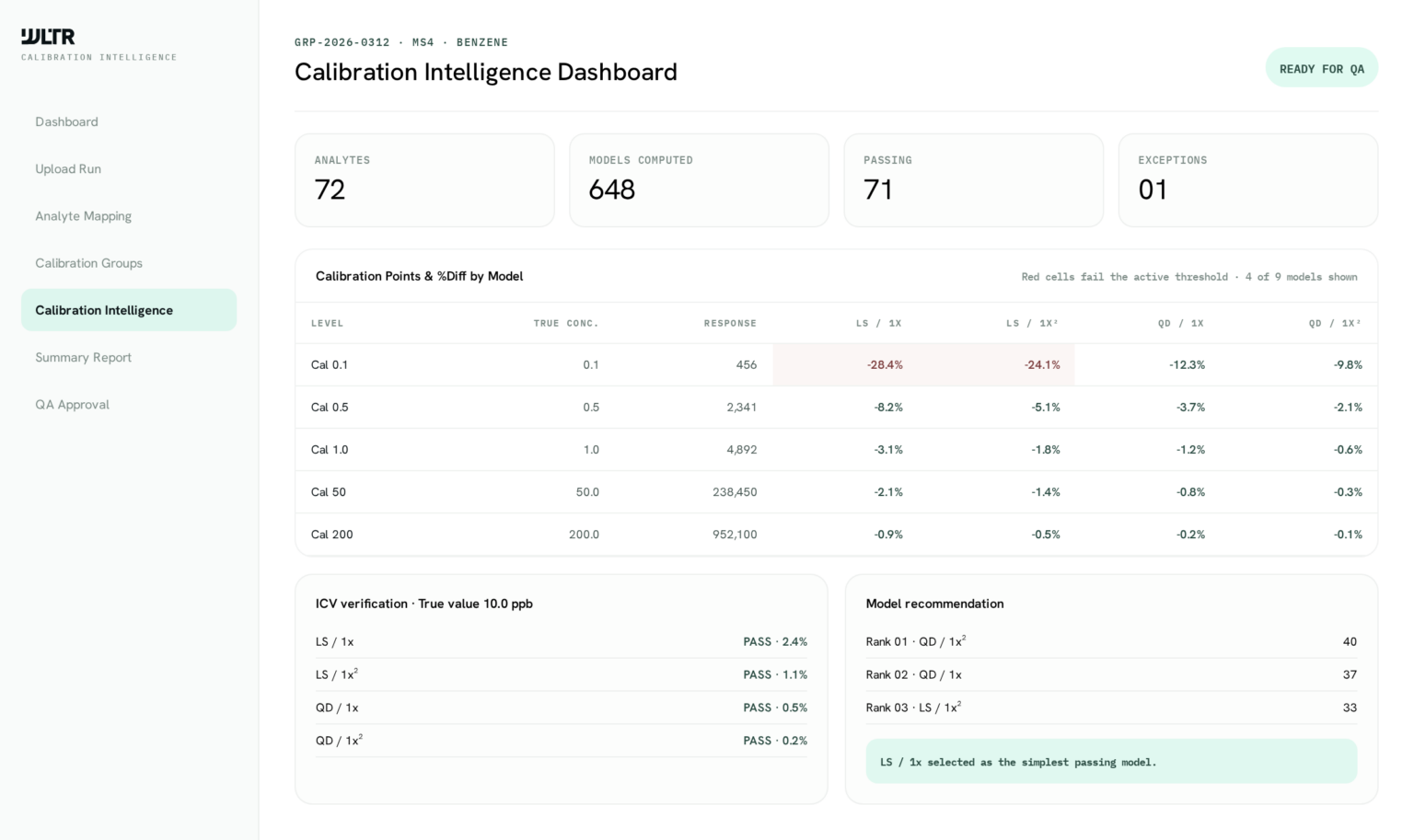
See the whole lab, not one run.
Trend calibration performance across runs, instruments, and analytes, and spot recurring failures before they become reassays or ISR investigations.
Your CDS remains the system of record. WLTR is the system of verification. WLTR complements your validated workflow. It does not replace your CDS, your LIMS, or your method validation. The WLTR methodology is patented (US 12,038,448 B2).
Where calibration risk hides
The calibration problems bioanalytical labs live with.
Weighting set once, never revisited
A 1/x² weighting chosen at validation may not suit a new matrix, a new instrument, or a method transferred from another site.
Wide dynamic ranges
Over three or four orders of magnitude, the correlation coefficient is dominated by the high standards while accuracy at the low end erodes.
Calibrators excluded to pass
Dropping standards within the 75% rule can keep a run acceptable, but a recurring pattern of exclusions usually points to a model problem.
Response nonlinearity
Ion suppression, matrix effects, and detector saturation bend LC-MS/MS response curves in ways a linear fit does not capture.
ISR and reassay investigations
When incurred sample reanalysis fails or reassays pile up, calibration fit is one of the first places investigators look.
Method transfer between sites
The same validated method can behave differently in a receiving laboratory. Comparable calibration evidence makes transfer defensible.
How it works
Three steps. No change to your validated method.
-
Export
Export calibration data from your chromatography data system for the runs you want verified.
-
Evaluate
WLTR fits your standards against the candidate calibration models, evaluates 19 acceptance criteria, and ranks model performance.
-
Review and document
Analysts, data reviewers, and QA receive a clear verification result per run and analyte, ready for data review, study files, and audits.
Regulatory alignment
Built around the expectations you already work to.
| Framework | What it expects | How WLTR supports it |
|---|---|---|
| ICH M10, Bioanalytical Method Validation and Study Sample Analysis (FDA guidance, November 2022) | At least six calibration levels including the LLOQ and ULOQ. Back-calculated concentrations within ±15% of nominal, ±20% at the LLOQ, for at least 75% of standards. Regression model and weighting determined during validation under written procedures. | Side-by-side model comparison and back-calculated accuracy review that support your model and weighting justification. |
| 21 CFR Part 58, Good Laboratory Practice | Nonclinical study data that is complete, accurate, and reconstructable. | A reproducible calibration evaluation that can be filed with the run and the study record. |
| 21 CFR 211.160 and 211.194, GMP laboratory controls and records | Scientifically sound standards and test procedures, with complete records of calculations and test data. | Independent verification evidence for second-person data review and batch record review. |
| 21 CFR Part 11 and ALCOA+ data integrity principles | Electronic records that are attributable, accurate, complete, and consistent. | An independent check of results produced by your CDS, without altering source data. |
Who it is for
Built for the people who sign off on the data.
- Bioanalytical laboratory directors
- Study directors and principal investigators
- QA managers and QAU auditors
- Method development and validation scientists
- LC-MS/MS analysts
- Data reviewers
- Sponsor quality oversight
Questions
Frequently asked questions
Does WLTR replace our CDS or LIMS?
No. Your chromatography data system remains the system of record and your LIMS continues to manage samples and reporting. WLTR is a verification layer that evaluates the calibration data your CDS already produces.
Do we need to change or revalidate our bioanalytical methods to use WLTR?
WLTR works from calibration data you export after a run. It does not change acquisition, integration, or processing in your validated method. How WLTR results are referenced in your SOPs is decided by your quality system.
Which techniques does WLTR support?
WLTR is built for quantitative methods that report against a calibration curve, including LC-MS/MS, HPLC, and UPLC assays used in bioanalysis, pharmacokinetic and toxicokinetic studies, and QC release testing.
How does WLTR help a CRO during sponsor audits and regulatory inspections?
WLTR gives your team a documented, reproducible evaluation of each calibration curve, including how the reported model compares with alternatives and how accurately each standard back-calculates. That record supports the questions sponsors and inspectors ask about model selection and weighting.
How do we get started?
Apply to the WLTR Pilot Program or request a demo. We will walk through your workflow and show how WLTR evaluates calibration data from your own runs.
Pilot program
See what WLTR finds in your calibration data.
Bring a recent run. We will show you how your reported curve holds up against 19 acceptance criteria, analyte by analyte.
References: ICH M10 Bioanalytical Method Validation and Study Sample Analysis (FDA) · 21 CFR Part 58 · 21 CFR Part 211