







Cannabis testing
Potency results that hold up when the state audits.
Cannabinoid potency, pesticides, residual solvents, mycotoxins. Every number on a certificate of analysis traces back to a calibration. WLTR tests each one against 19 acceptance criteria so your lab can defend the results that regulators and license holders scrutinize.
What WLTR adds to your data
A passing calibration is not the same as a defensible one.
State cannabis programs hold testing labs to ISO/IEC 17025 and audit the accuracy of what they report. WLTR independently evaluates your calibration standards, ranks how well each established model fits, and documents the result for every analyte on every instrument.
Defend every THC number
Potency drives price, labeling and compliance. WLTR shows how accurately each calibration standard recalculates, so the THC and CBD values on a certificate of analysis rest on documented evidence.
Accuracy at pass and fail limits
Pesticide, mycotoxin and residual solvent results are judged against state action levels. WLTR evaluates 19 acceptance criteria, including low-end accuracy, so bias near an action level surfaces before a batch is passed or failed.
Every compound, every instrument
Pesticide panels can run 60 or more analytes per injection. See which compounds and instruments struggle, and trend them over time. Multi-analyte oversight
Records that stand up to the state
A documented, reproducible calibration evaluation supports ISO/IEC 17025 assessments, state audits and challenges to a reported result. Audit defensibility
See it for yourself
Same calibration. Three models. Three different answers.
Switch the calibration model and watch how accurately each standard recalculates. The unweighted linear fit posts an r² above 0.998 and still misses badly at the low end, right where action levels and limits of quantitation live.
How to read this: each dot is one calibration standard. The closer to the center line, the more accurately that standard is recovered. Pick a regression model:
Recalculated accuracy of each calibration standard. Shaded band shows an example ±20% acceptance window; your method and SOP set the actual criteria. Illustrative data.
Inside WLTR
From ICAL export to a defensible record.
Step 01
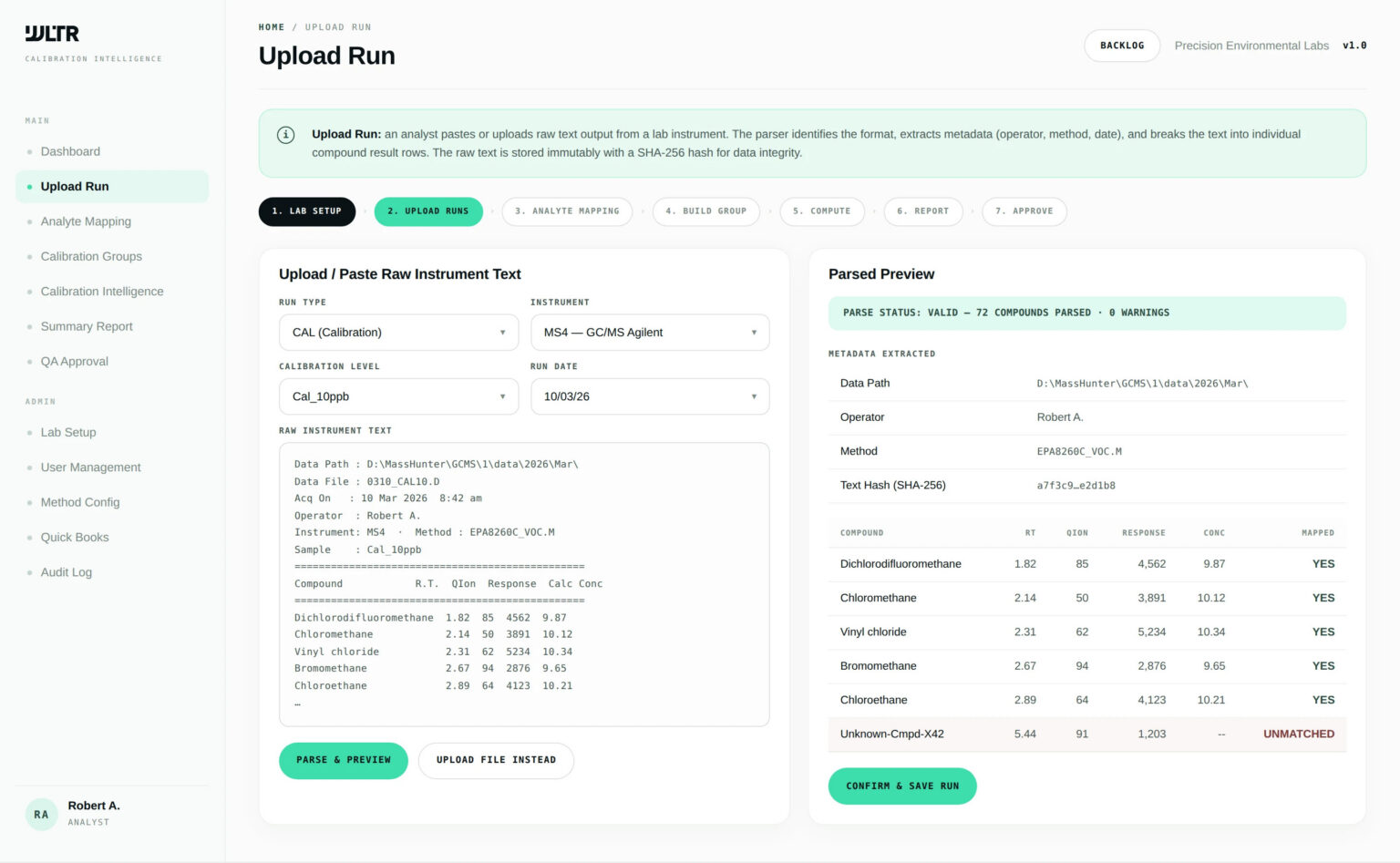
Upload the calibration straight from your data system.
Drop in the calibration export from your HPLC, LC-MS/MS or GC-MS data system. WLTR parses the run and confirms instrument and method context. Nothing about how your instruments acquire or process data changes.
Step 02
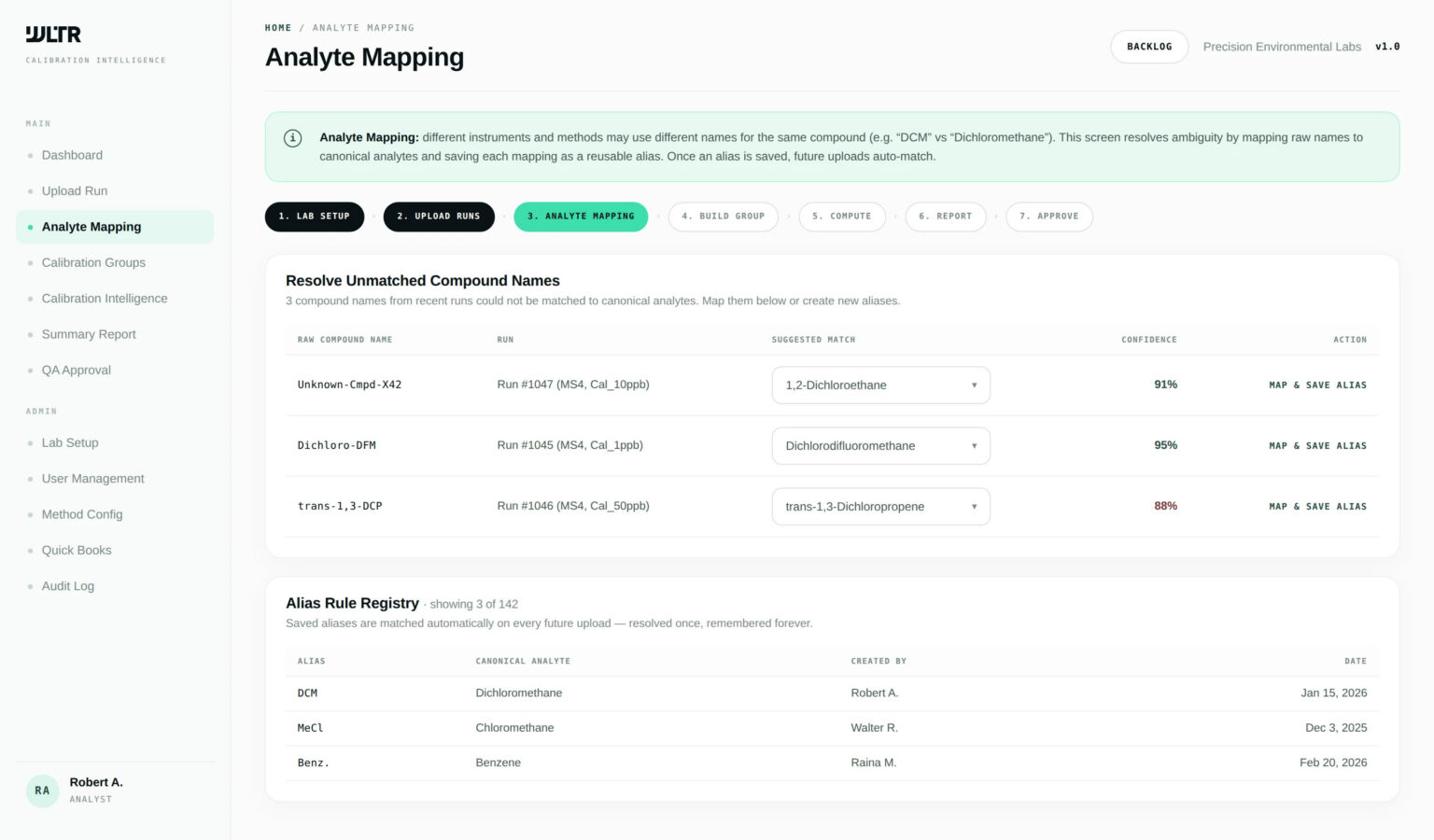
Pesticide panels, mapped once.
Compound names rarely match across instruments and software. WLTR maps every analyte to a consistent name so results can be trended across runs and instruments.
Step 03
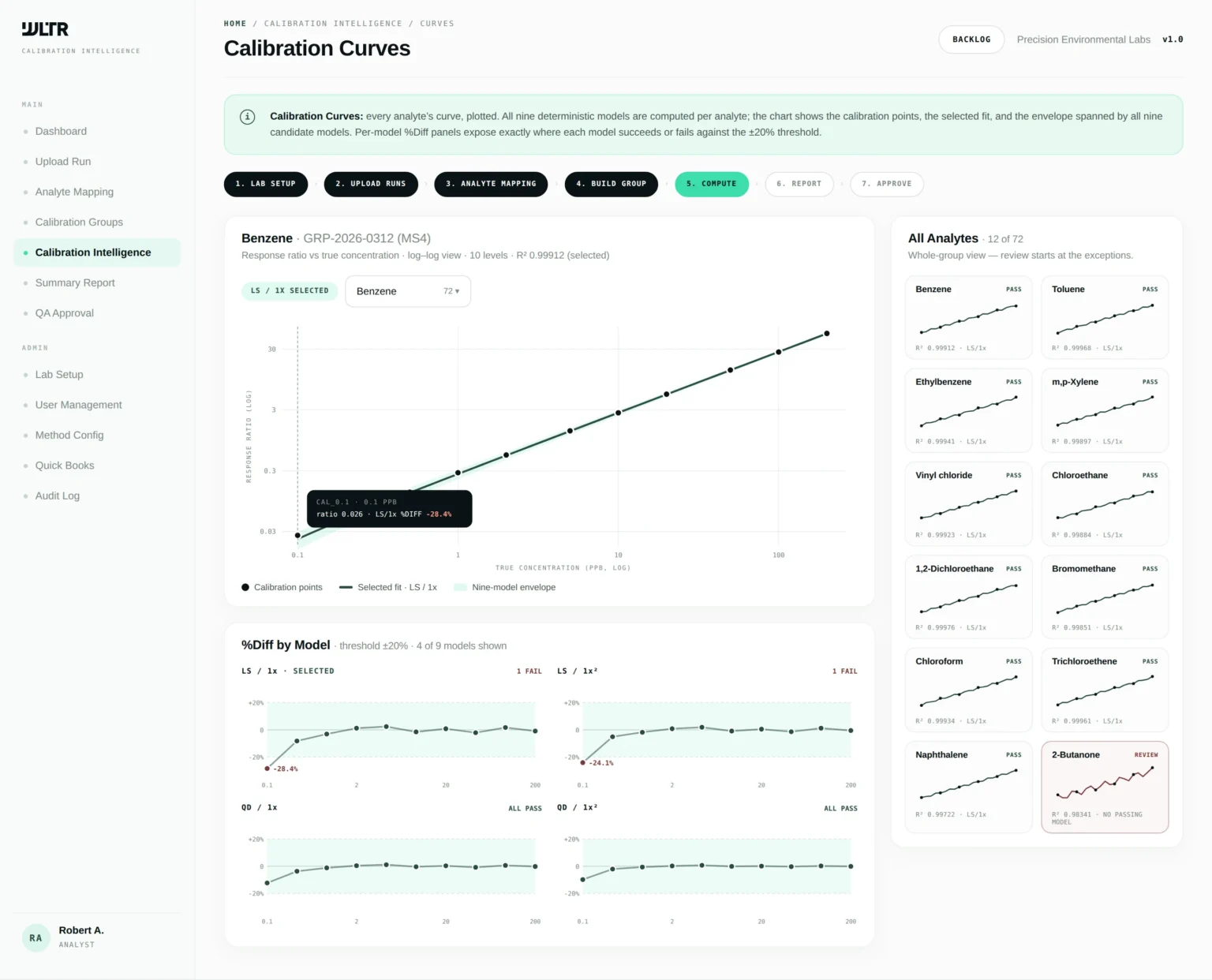
Every compound, every model, side by side.
WLTR fits each analyte against the candidate calibration models and shows how accurately every standard recalculates, so curvature and low-end bias are visible at a glance.
Step 04
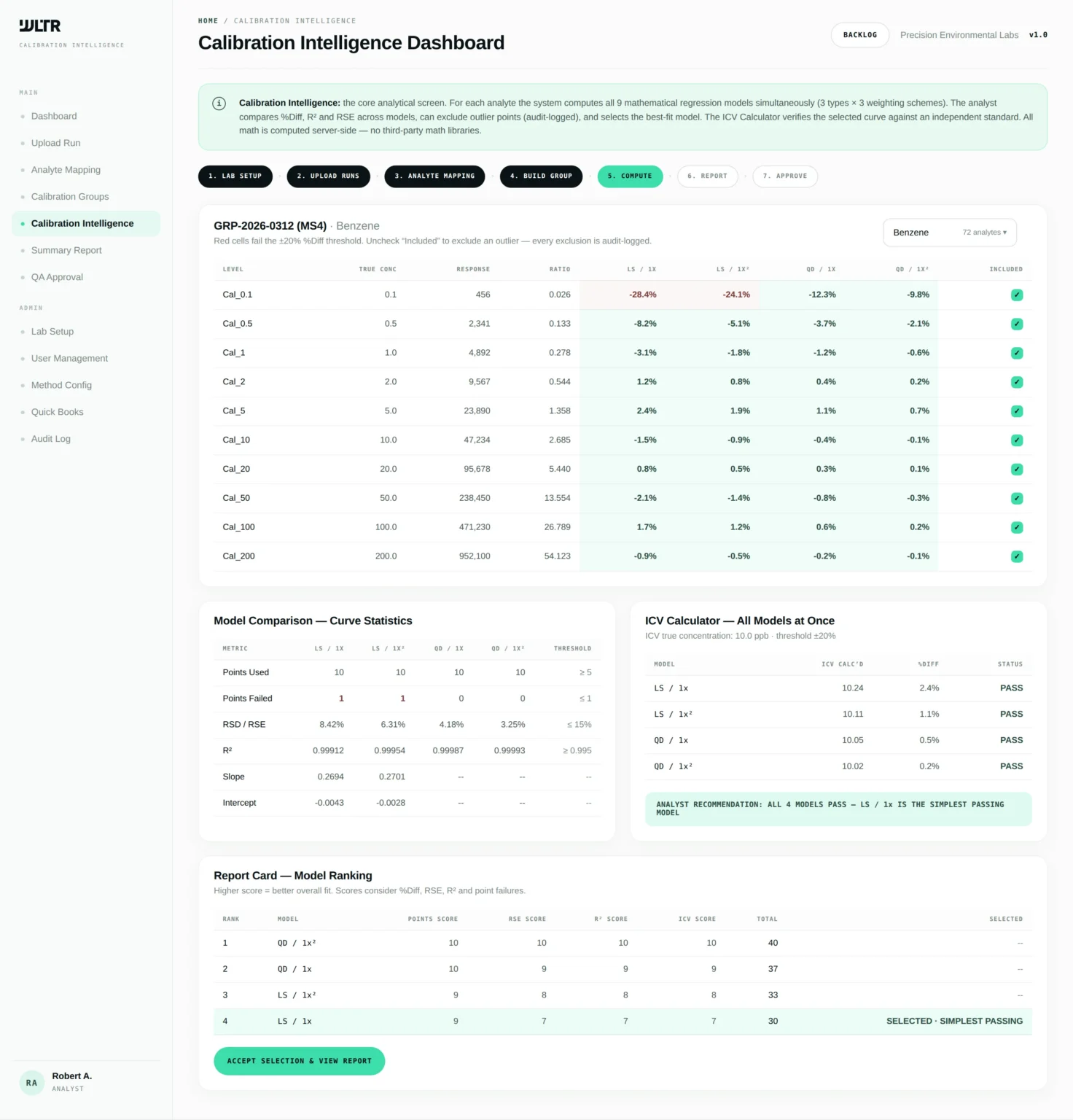
A ranked, documented recommendation.
All 19 acceptance criteria roll up into a ranked model comparison with a clear recommendation and the evidence behind it, ready for data review and your data package.
Your CDS remains the system of record. WLTR is the system of verification. WLTR complements your accredited methods. It does not replace your CDS, your LIMS, or your method SOPs. The WLTR methodology is patented (US 12,038,448 B2).
Where calibration risk hides
The calibration problems cannabis labs live with.
Pressure to report higher potency
Clients shop for higher THC numbers. A calibration that drifts high at the top of the range becomes inflated potency and regulatory exposure.
Calibrations that pass on r² alone
A high correlation coefficient can hide large errors at the low and high ends of the curve.
Low standards near action levels
When the lowest standard fails to recalculate, every pesticide or mycotoxin result near its action level is in question.
A range that does not bracket results
High-potency concentrates often land above the top calibration standard, forcing dilutions and reruns.
Reruns and lost instrument time
Recurring calibration failures cost recalibration, reanalysis and delayed certificates for clients.
Audit findings and license risk
Calibration findings in a state audit can lead to corrective action, suspended testing or action against the lab license.
How it works
Three steps. No change to your methods.
-
Export
Export calibration data from your chromatography data system.
-
Evaluate
WLTR fits your standards against the candidate calibration models, evaluates 19 acceptance criteria, and ranks model performance for each analyte.
-
Review and document
Analysts, data reviewers, and QA receive a clear verification result per analyte and instrument, ready for data review, data packages, and assessments.
Regulatory alignment
Built around the standards your lab is assessed against.
| Framework | What it covers | How WLTR supports it |
|---|---|---|
| ISO/IEC 17025:2017 | Competence requirements that state cannabis programs use as the basis for laboratory accreditation. | Documented, reproducible calibration evidence for accreditation assessments. |
| State cannabis testing regulations | State rules that set required analytes, action levels and laboratory quality requirements. | Calibration evidence behind results reported against state action levels. |
| AOAC standard method performance requirements | Performance requirements for cannabinoid quantitation in cannabis products. | Recalculated accuracy across the calibration range for each cannabinoid. |
| Certificate of analysis requirements | State requirements for what a certificate of analysis reports and how results are labeled. | An auditable record of the calibration behind every reported value. |
Who it is for
Built for the people who sign the report.
- Laboratory directors
- Quality managers
- HPLC, LC-MS/MS and GC-MS analysts
- Data reviewers
- Compliance managers
- Client services
Questions
Frequently asked questions
Does WLTR replace our CDS or LIMS?
No. Your chromatography data system remains the system of record and your LIMS continues to manage samples, reporting and certificates of analysis. WLTR is a verification layer that evaluates the calibration data your instruments already produce.
Will WLTR help with state audits and ISO/IEC 17025 assessments?
WLTR gives your lab a documented, reproducible evaluation of each calibration, including how the model you report compares with alternatives and how accurately each standard recalculates. That record supports the calibration questions accreditation and state auditors ask.
Which tests does WLTR work with?
Any test that quantitates against a calibration curve, including cannabinoid potency by HPLC, pesticides and mycotoxins by LC-MS/MS and GC-MS, and residual solvents by headspace GC.
Do we have to change our methods or SOPs?
WLTR works from calibration data you export after a run. It does not change how your instruments acquire or process data. How WLTR results are referenced in your SOPs is decided by your quality system.
How do we get started?
Apply to the WLTR Pilot Program or request a demo. We will review your workflow and show how WLTR evaluates calibrations from your own instruments.
Pilot program
See what WLTR finds in your potency calibrations.
Bring a recent calibration. We will show you how each analyte’s reported calibration holds up against 19 acceptance criteria.
References: ISO/IEC 17025:2017 · AOAC Cannabis Analytical Science Program · WLTR Standards Hub