







Food and beverage testing
Defend every residue result before it leaves the lab.
Pesticide residues, mycotoxins, PFAS, veterinary drugs. Every result traces back to a calibration. WLTR tests each one against 19 acceptance criteria so your lab can stand behind the numbers that growers, brands, importers and regulators act on.
What WLTR adds to your data
A passing calibration is not the same as the right calibration.
Multi-residue methods quantitate hundreds of analytes against calibrations that are rarely reviewed analyte by analyte. WLTR independently evaluates your calibration standards, ranks how well each established model fits, and documents the result for every analyte on every instrument.
The right fit, backed by evidence
WLTR evaluates the candidate calibration models side by side against 19 acceptance criteria, so the option your lab reports for each analyte is supported by data rather than habit or software defaults.
Accuracy where decisions are made
Residue results are judged against maximum residue limits, tolerances and action levels. WLTR evaluates 19 acceptance criteria, including low-end accuracy, so bias near a limit surfaces before a lot is released or rejected.
Every residue, every instrument
Multi-residue panels can run hundreds of pesticides per injection. See which compounds and instruments struggle, and trend them over time. Multi-analyte oversight
Records that stand up to review
A documented, reproducible calibration evaluation supports ISO/IEC 17025 assessments, FDA LAAF accreditation and customer audits. Audit defensibility
See it for yourself
Same calibration. Three models. Three different answers.
Switch the calibration model and watch how accurately each standard recalculates. The unweighted linear fit posts an r² above 0.998 and still misses badly at the low end, right where limits of quantitation and maximum residue limits live.
How to read this: each dot is one calibration standard. The closer to the center line, the more accurately that standard is recovered. Pick a regression model:
Recalculated accuracy of each calibration standard. Shaded band shows an example ±20% acceptance window; your method and SOP set the actual criteria. Illustrative data.
Inside WLTR
From ICAL export to a defensible record.
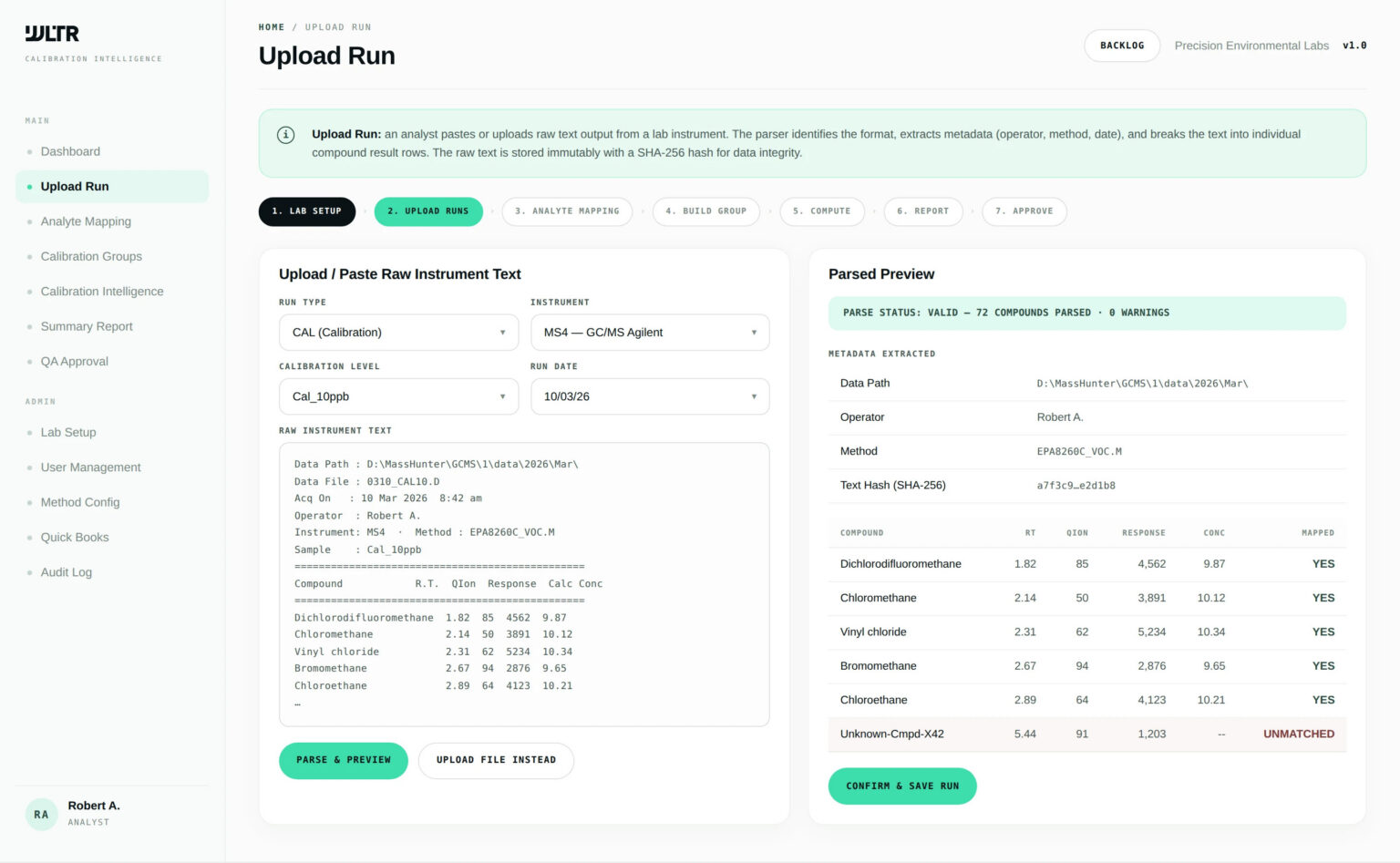
Step 01
Upload the calibration straight from your data system.
Drop in the calibration export from your GC-MS/MS or LC-MS/MS data system. WLTR parses the run and confirms instrument and method context. Nothing about how your instruments acquire or process data changes.
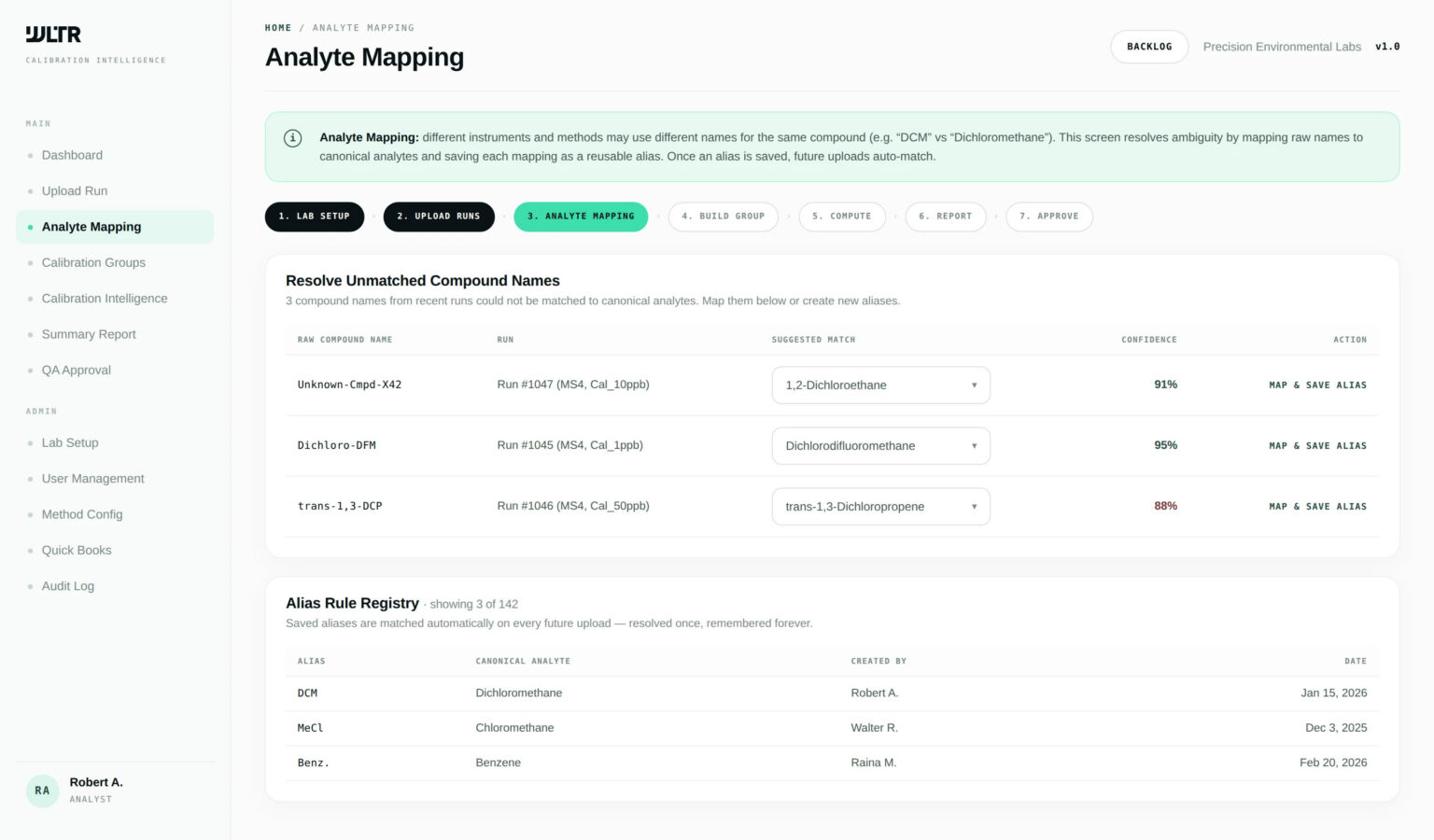
Step 02
Residue panels, mapped once.
Pesticide names rarely match across instruments, software and methods. WLTR maps every analyte to a consistent name so results can be trended across runs and instruments.
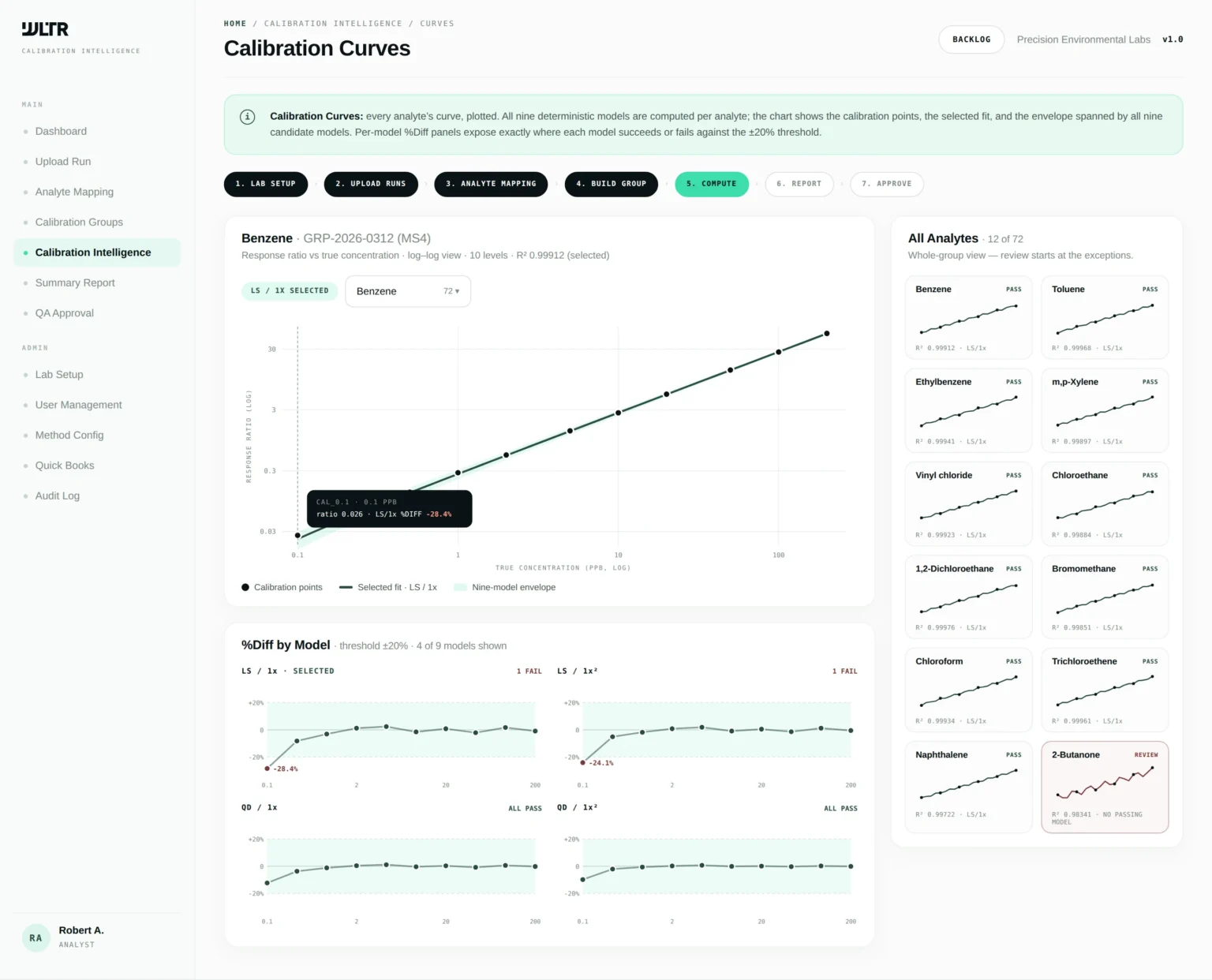
Step 03
Every compound, every model, side by side.
WLTR fits each analyte against the candidate calibration models and shows how accurately every standard recalculates, so curvature and low-end bias are visible at a glance.
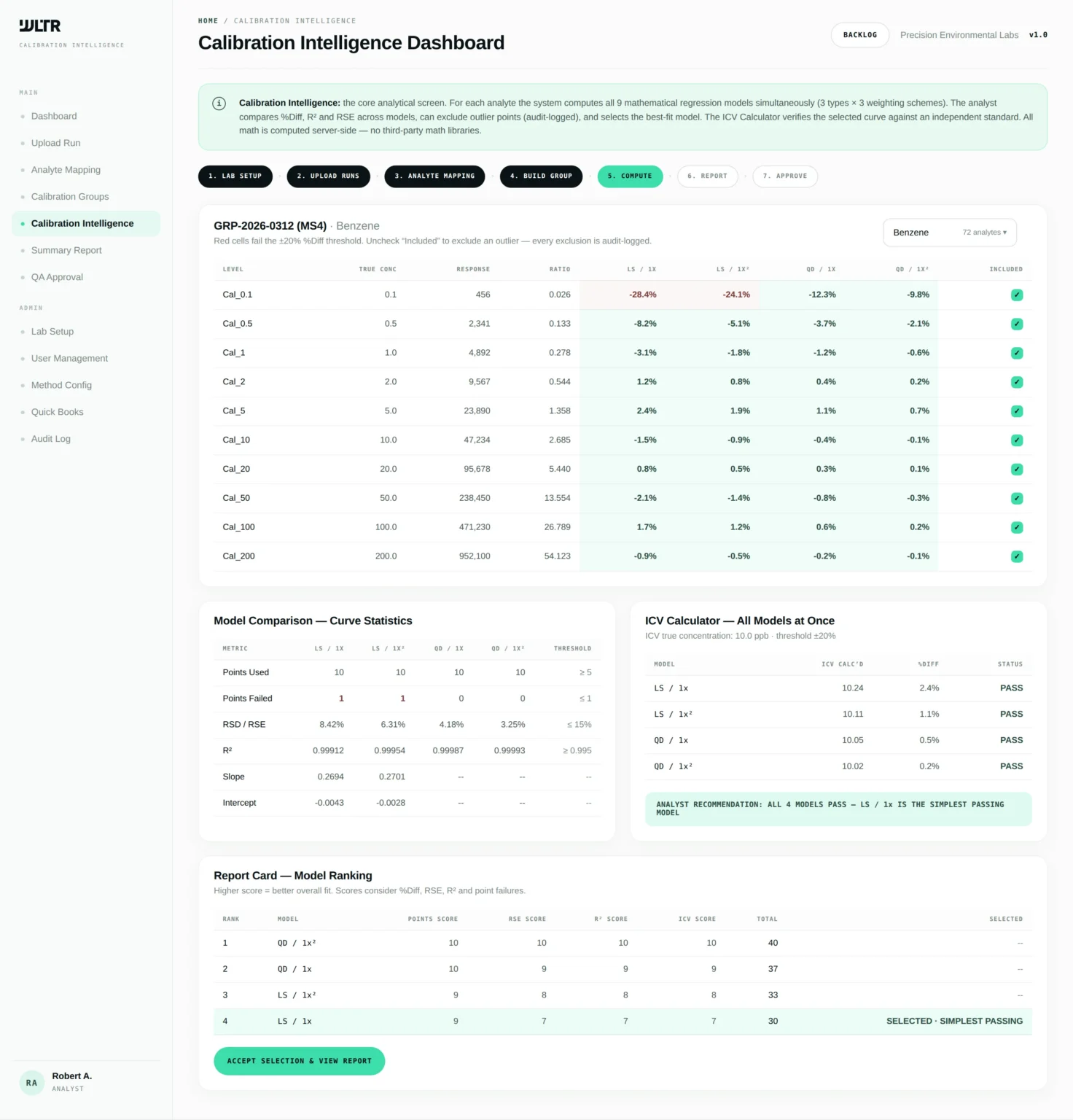
Step 04
A ranked, documented recommendation.
All 19 acceptance criteria roll up into a ranked model comparison with a clear recommendation and the evidence behind it, ready for data review and your data package.
Your CDS remains the system of record. WLTR is the system of verification. WLTR complements your accredited methods. It does not replace your CDS, your LIMS, or your method SOPs. The WLTR methodology is patented (US 12,038,448 B2).
Where calibration risk hides
The calibration problems food testing labs live with.
Hundreds of analytes, little review time
Large panels mean individual calibrations get checked against a pass or fail flag rather than examined.
Matrix effects across commodities
Matrix effects vary by commodity. A calibration that fits in one matrix can bias results in another.
Low standards near MRLs
When the lowest standard fails to recalculate, results near a maximum residue limit are in question.
Quadratic fits used to rescue a curve
Switching to a quadratic can make a calibration pass while masking detector saturation or a failing standard.
Reruns and missed turnaround
Recurring calibration failures cost reanalysis and delay the results that shipments and releases depend on.
Disputed results
A result that leads to a rejected lot or an import detention will be challenged. The calibration behind it needs to hold up.
How it works
Three steps. No change to your methods.
-
Export
Export calibration data from your chromatography data system.
-
Evaluate
WLTR fits your standards against the candidate calibration models, evaluates 19 acceptance criteria, and ranks model performance for each analyte.
-
Review and document
Analysts, data reviewers, and QA receive a clear verification result per analyte and instrument, ready for data review, data packages, and assessments.
Regulatory alignment
Built around the standards your lab is assessed against.
| Framework | What it covers | How WLTR supports it |
|---|---|---|
| ISO/IEC 17025:2017 | Competence requirements food testing laboratories are accredited against. | Documented, reproducible calibration evidence for accreditation assessments. |
| FDA LAAF (21 CFR Part 1, Subpart R) | FDA accreditation program for laboratories performing certain food testing, including import alert removal and directed testing. | Calibration evidence that supports the fit-for-purpose method requirement. |
| SANTE/11312/2021 | European analytical quality control guidance for pesticide residue analysis, widely used by food laboratories. | Recalculated accuracy and residual checks for each analyte in the calibration. |
| FDA Foods Program method validation guidelines | Guidelines for validating chemical methods used in FDA food testing. | Model comparison and accuracy evidence across the calibration range. |
Who it is for
Built for the people who sign the report.
- Laboratory directors
- Quality managers
- Residue chemists and analysts
- GC-MS/MS and LC-MS/MS operators
- Data reviewers
- Client services and account managers
Questions
Frequently asked questions
Does WLTR replace our CDS or LIMS?
No. Your chromatography data system remains the system of record and your LIMS continues to manage samples and reporting. WLTR is a verification layer that evaluates the calibration data your instruments already produce.
Does WLTR support LAAF and ISO/IEC 17025 accreditation?
WLTR gives your lab a documented, reproducible evaluation of each calibration, including how the model you report compares with alternatives and how accurately each standard recalculates. That record supports the calibration questions assessors and customers ask.
Which methods does WLTR work with?
Methods that quantitate against a calibration curve, including multi-residue pesticide analysis by GC-MS/MS and LC-MS/MS, mycotoxins, veterinary drug residues and PFAS in food.
Do we have to change our methods or SOPs?
WLTR works from calibration data you export after a run. It does not change how your instruments acquire or process data. How WLTR results are referenced in your SOPs is decided by your quality system.
How do we get started?
Apply to the WLTR Pilot Program or request a demo. We will review your workflow and show how WLTR evaluates calibrations from your own instruments.
Pilot program
See what WLTR finds in your residue calibrations.
Bring a recent calibration. We will show you how each analyte’s reported calibration holds up against 19 acceptance criteria.
References: FDA LAAF · ISO/IEC 17025:2017 · WLTR Standards Hub