






Forensic toxicology
Calibrations built to hold up on the witness stand.
Blood alcohol, drugs of abuse, postmortem toxicology. Every reported concentration traces back to a calibration model. WLTR tests each one against 19 acceptance criteria so your analysts can defend the model in technical review, in discovery and in court.
What WLTR adds to your data
A passing calibration is not the same as a defensible one.
ANSI/ASB Standard 036 asks labs to use the simplest calibration model that fits, apply weighting when variance changes across the range, and evaluate residuals rather than relying on r² alone. WLTR independently evaluates your calibration standards against those questions and documents the result for every analyte on every instrument.
The simplest model that fits, documented
WLTR evaluates the candidate calibration models side by side against 19 acceptance criteria, so the model your lab uses is supported by evidence rather than habit or software defaults.
Accuracy at decision points
Per se limits, reporting limits and cutoffs are where results get challenged. WLTR shows how accurately low calibrators recalculate before a result is reported.
Every drug, every instrument
Confirmation panels span dozens of drugs and metabolites. See which analytes and instruments struggle, and trend them over time. Multi-analyte oversight
Records ready for discovery
A documented, reproducible calibration evaluation supports technical review, accreditation assessments and expert testimony. Audit defensibility
See it for yourself
Same calibration. Three models. Three different answers.
Switch the calibration model and watch how accurately each calibrator recalculates. The unweighted linear fit posts an r² above 0.998 and still misses badly at the low end, right where cutoffs and reporting limits live.
How to read this: each dot is one calibration standard. The closer to the center line, the more accurately that standard is recovered. Pick a regression model:
Recalculated accuracy of each calibration standard. Shaded band shows an example ±20% acceptance window; your method and SOP set the actual criteria. Illustrative data.
Inside WLTR
From ICAL export to a defensible record.
Step 01
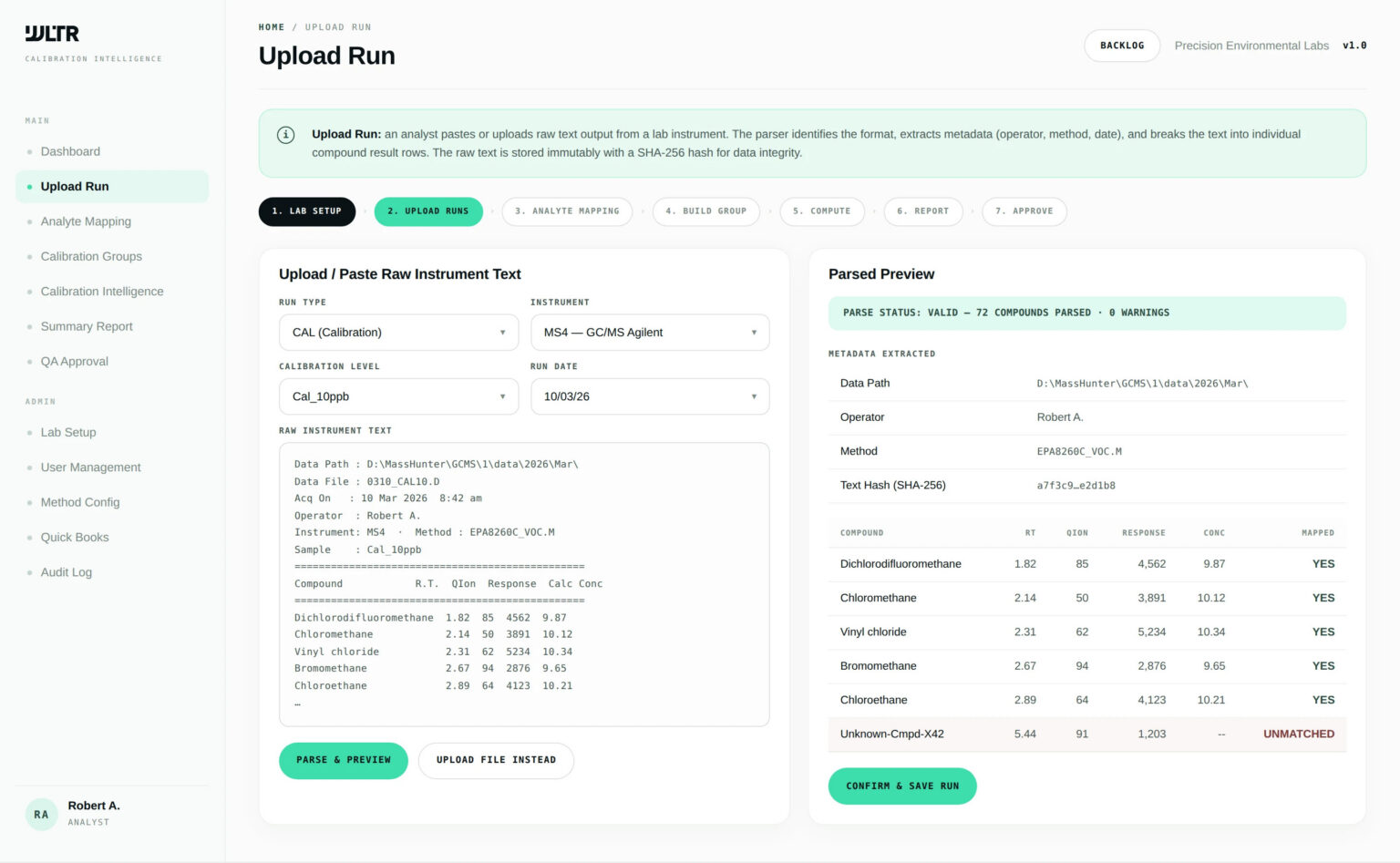
Upload the calibration straight from your data system.
Drop in the calibration export from your headspace GC, GC-MS or LC-MS/MS data system. WLTR parses the run and confirms instrument and method context. Nothing about how your instruments acquire or process data changes.
Step 02
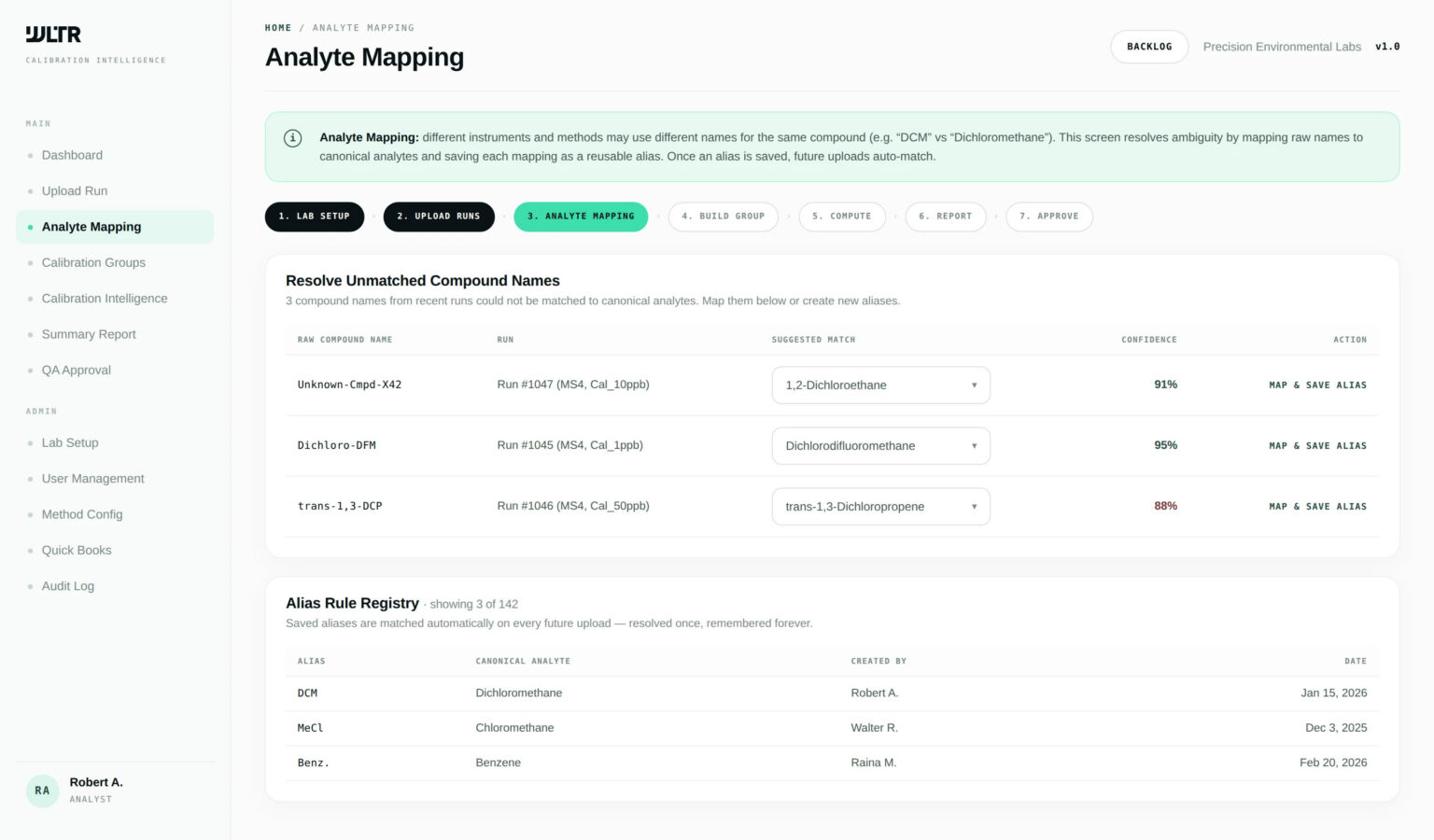
Drug panels, mapped once.
Drug and metabolite names rarely match across instruments and software. WLTR maps every analyte to a consistent name so results can be trended across runs and instruments.
Step 03
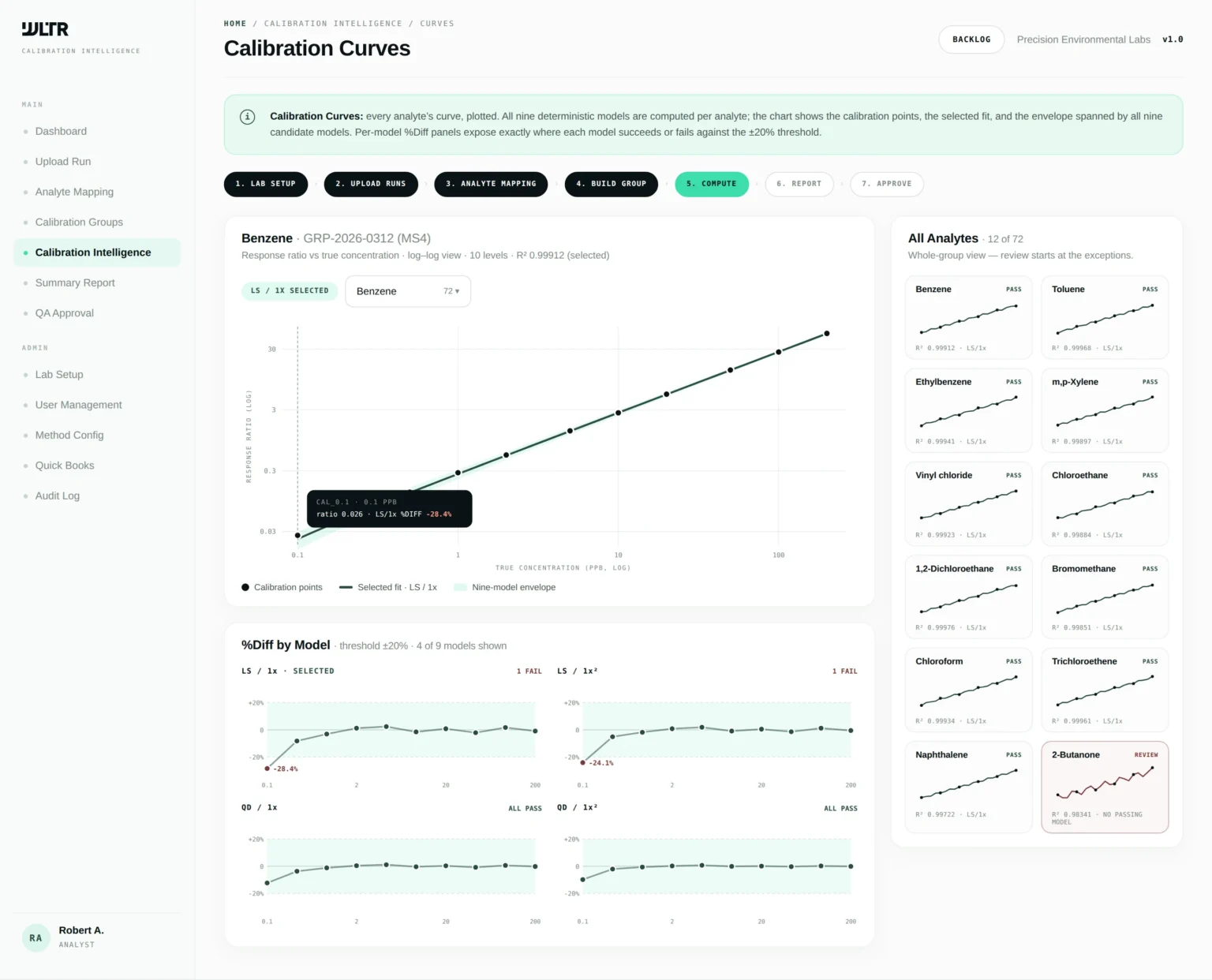
Every compound, every model, side by side.
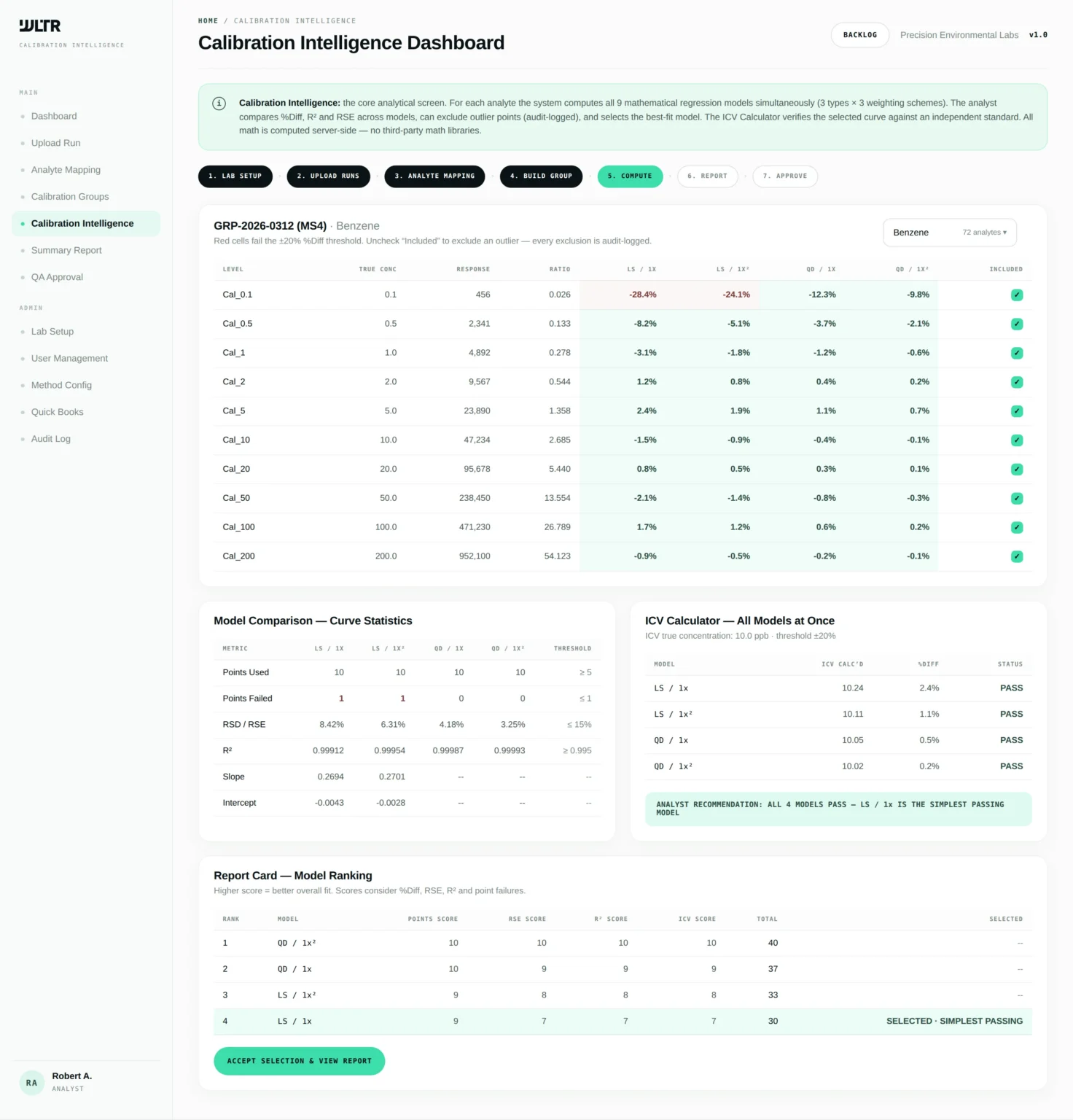
WLTR fits each analyte against the candidate calibration models and shows how accurately every standard recalculates, so curvature and low-end bias are visible at a glance.
Step 04
A ranked, documented recommendation.
All 19 acceptance criteria roll up into a ranked model comparison with a clear recommendation and the evidence behind it, ready for data review and your data package.
Your CDS remains the system of record. WLTR is the system of verification. WLTR complements your accredited methods. It does not replace your CDS, your LIMS, or your method SOPs. The WLTR methodology is patented (US 12,038,448 B2).
Where calibration risk hides
The calibration problems forensic toxicology labs live with.
Calibrator and sample matrix mismatch
Aqueous calibrators run against whole-blood samples can introduce bias that a high r² will not show.
r² used as the acceptance test
The correlation coefficient does not measure accuracy, and opposing experts know it.
Weighting chosen by default
An unweighted fit across a wide range can bias the low end, where per se limits and cutoffs sit.
Low calibrators that will not recalculate
When the lowest calibrator fails, every result near the reporting limit is open to challenge.
Backlogs and reruns
Recurring calibration failures cost reanalysis and add to case backlogs.
Challenges in court
Calibration questions raised in discovery or on cross-examination can put a result, and the lab’s credibility, at risk.
How it works
Three steps. No change to your methods.
-
Export
Export calibration data from your chromatography data system.
-
Evaluate
WLTR fits your standards against the candidate calibration models, evaluates 19 acceptance criteria, and ranks model performance for each analyte.
-
Review and document
Analysts, data reviewers, and QA receive a clear verification result per analyte and instrument, ready for data review, data packages, and assessments.
Regulatory alignment
Built around the standards your lab is assessed against.
| Framework | What it covers | How WLTR supports it |
|---|---|---|
| ANSI/ASB Standard 036 | Method validation in forensic toxicology, including calibration model evaluation, weighting and residual analysis. | Model comparison, weighting evaluation and recalculated accuracy for each analyte. |
| ANSI/ASB Standard 054 | Quality control program requirements for forensic toxicology laboratories. | Ongoing calibration evidence alongside your QC program. |
| ISO/IEC 17025:2017 forensic accreditation | Competence requirements forensic laboratories are accredited against, through bodies such as ANAB. | Documented, reproducible calibration evidence for assessments. |
| OSAC Registry | Forensic science standards listed by NIST OSAC for adoption by laboratories. | Calibration evaluation aligned with registry toxicology standards. |
Who it is for
Built for the people who sign the report.
- Laboratory directors
- Technical leaders and toxicology supervisors
- Quality managers
- Forensic toxicologists and analysts
- Technical reviewers
- Expert witnesses
Questions
Frequently asked questions
Does WLTR replace our CDS or LIMS?
No. Your chromatography data system remains the system of record and your LIMS continues to manage samples and reporting. WLTR is a verification layer that evaluates the calibration data your instruments already produce.
How does WLTR relate to ANSI/ASB Standard 036?
Standard 036 sets out how calibration models should be evaluated during method validation. WLTR gives your lab a documented, reproducible evaluation of the candidate models, weighting and recalculated accuracy for each analyte, which supports that work and the ongoing review of calibrations after validation.
Can WLTR results be used in court?
WLTR produces a documented record of how each calibration was evaluated. How that record is used in case files, discovery and testimony is decided by your laboratory and its legal partners.
Which tests does WLTR work with?
Any test that quantitates against a calibration curve, including blood alcohol by headspace GC and drug confirmation and quantitation by GC-MS and LC-MS/MS.
How do we get started?
Apply to the WLTR Pilot Program or request a demo. We will review your workflow and show how WLTR evaluates calibrations from your own instruments.
Pilot program
See what WLTR finds in your calibrations.
Bring a recent calibration. We will show you how each analyte’s calibration holds up against 19 acceptance criteria, with the record a technical reviewer or opposing expert will ask for.
References: ANSI/ASB Standard 036 · OSAC Registry · WLTR Standards Hub